Future Thinking: How Future Design, Logs, Schools, and Gaming Are Changing the World
Good future thinking is a skill, not just a disposition. It requires structured methods for imagining multiple scenarios rather than defaulting to either optimism or dread. Future design has emerged as a discipline that applies systems thinking and speculative methodology to organizational and policy problems. The future log in bullet journaling is one of the simplest practical tools for personal future thinking, giving a monthly view of upcoming commitments and goals. Future schools are reimagining what learning environments look like when they are built around the skills and social structures that a rapidly changing world actually requires. And future gaming is both a category of video game design and a methodology for experiential foresight work.
Each of these domains is developing faster than most people track. This article gives a clear overview of all five.
Future Thinking in Practice: Design, Logs, Schools, and Games
Future thinking as a formal practice is rooted in futures studies and strategic foresight, fields that grew out of post-World War II military and policy planning. The goal is not prediction, which is generally not possible for complex systems, but preparation. Good future thinking identifies a range of plausible scenarios, examines their drivers and dependencies, and develops strategies that remain useful across multiple possible futures.
Future design as an emerging discipline extends this into participatory processes. Organizations like Future Design Lab in Japan have developed methodologies for including imagined future generations in current decision-making. Participants take on the role of “future people” in structured deliberations, advocating for choices that serve interests beyond the present generation. Future design processes have been used in municipal planning, healthcare policy, and corporate strategy. The core insight is that standard decision-making processes are structurally biased toward present costs and present stakeholders, and future design creates a corrective mechanism.
The future log in personal planning is a much more modest tool, but it addresses the same structural problem at the individual level. Without a future log, most people manage upcoming commitments through a combination of calendar apps and memory. The future log in a bullet journal provides a dedicated collection point for events and goals that fall beyond the current month: a visual reminder that the future is real and requires preparation. A well-maintained future log also makes migration into monthly planning much easier, because the material is already captured and organized by time horizon.
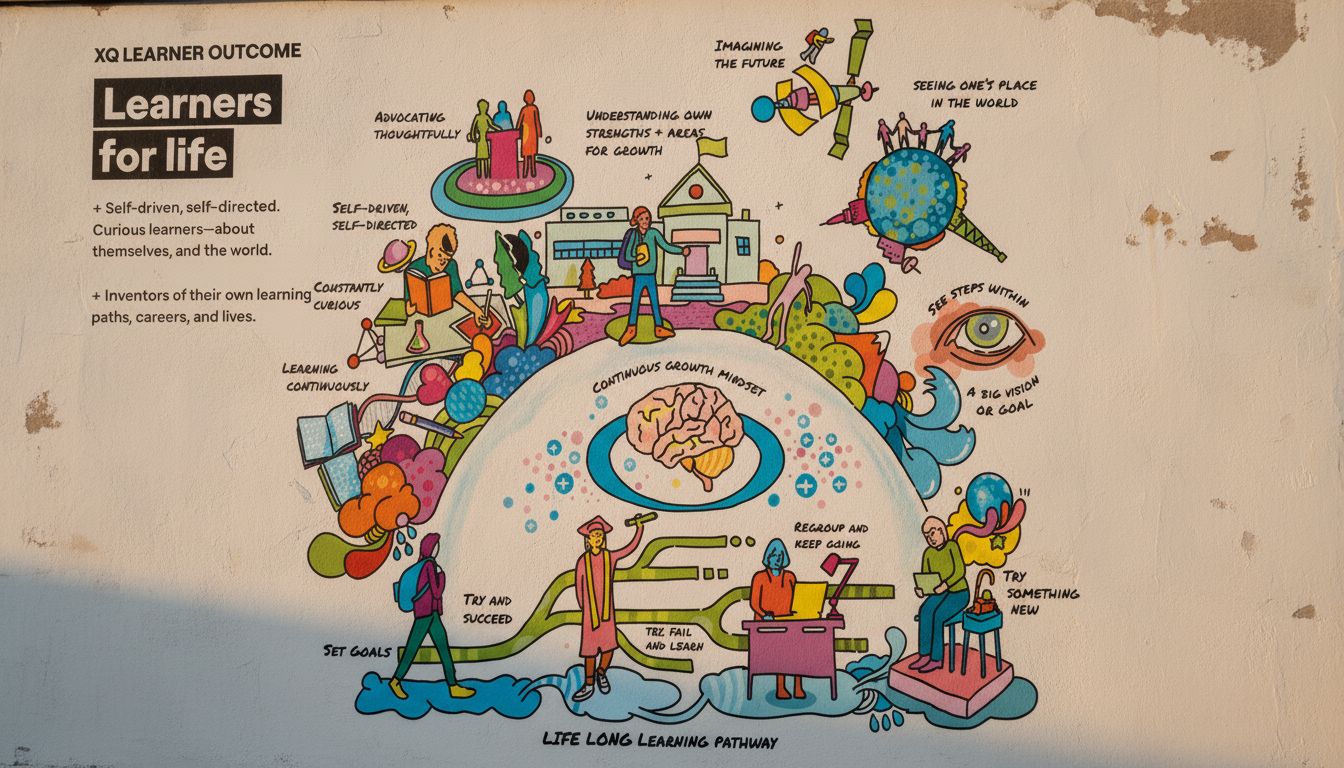
Future schools are educational institutions being designed from the ground up around skills, social structures, and pedagogical approaches suited to a post-industrial economy and an uncertain future. This includes project-based and inquiry-driven learning models, explicit social-emotional skill development, personalized pacing enabled by technology, and community-integrated experiences that connect academic work to real-world contexts. Future schools are not primarily about technology. The schools that have achieved the most documented success focus on relationships, mentorship, and student agency rather than devices and platforms.
The future schools movement draws on evidence from alternative education research, cognitive science on how learning actually happens, and economic analysis of which skills are most durable in changing labor markets. Reading, writing, critical thinking, collaboration, and self-directed learning appear consistently across these analyses as foundational. Future schools are designed to build these capacities more intentionally than traditional schools, which were designed primarily for a 20th-century industrial economy.
Future gaming covers several distinct categories. As a video game genre, future gaming includes science fiction settings that extrapolate current technological trajectories into imagined worlds: space exploration games, post-apocalyptic survival games, and social simulation games set in alternative futures. These games serve a cultural function, giving players a space to inhabit possible futures and develop intuitions about their consequences.
Future gaming also describes the use of game mechanics in futures and foresight work. Organizations use simulation games and role-play exercises to help participants experience the dynamics of possible futures in ways that pure analysis does not produce. A game that puts players in the position of managing a city through a climate disruption scenario builds different intuitions than a report that describes the same scenario. Future gaming in this sense is an experiential learning tool with documented applications in military planning, policy analysis, and organizational resilience work.
Bottom line: Future thinking is a learnable discipline, not a natural gift. Future design, future logs, future schools, and future gaming are all practical implementations of the core insight that deliberately engaging with possible futures produces better decisions than reacting to them as they arrive. Starting with one tool, whether a simple future log or a structured scenario exercise, builds the habit of looking ahead that the other practices can build on.