Greek Philosophy: Ideas That Still Shape How We Think
Greek philosophy gave the Western world its first systematic attempt to explain reality, morality, and the human condition through reason rather than myth. Ancient Greek philosophy stretches back more than 2,500 years, yet its questions remain current: What is knowledge? What makes a good life? What is justice? Ancient Greece philosophy produced thinkers whose work is still read in universities, courtrooms, and therapy offices. Greek philosophy quotes appear on walls, in speeches, and in self-help books because the ideas behind them have not aged. If you have ever asked “what is greek philosophy?”, the short answer is: the original project of thinking carefully about everything.
The Major Schools and What They Believed
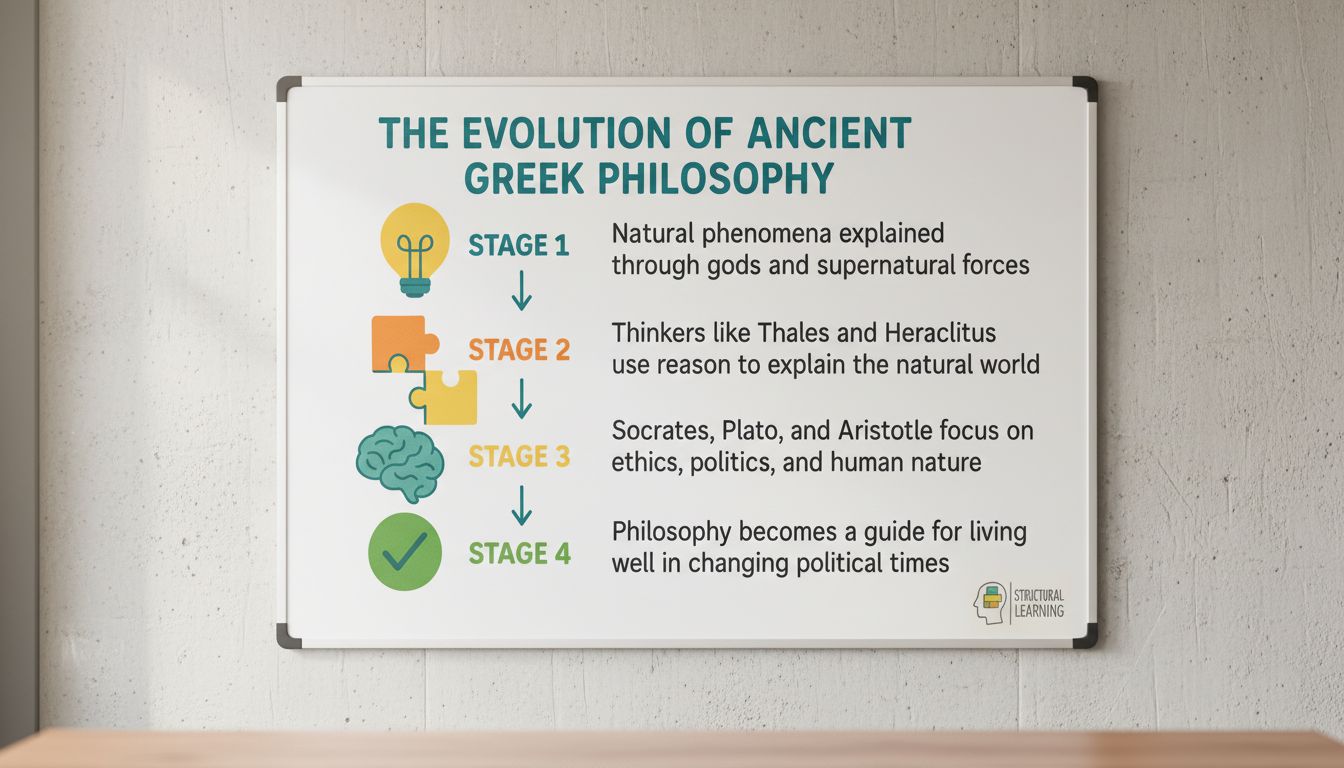
Ancient Greek philosophy does not belong to one school or one era. It spans roughly six centuries and several distinct traditions. The pre-Socratics, such as Thales, Heraclitus, and Parmenides, focused on the physical world. They asked what everything is made of and how change is possible. Their answers ranged from “water” to “fire” to “unchanging being,” but their method, using observation and argument rather than prayer, set the template for scientific thinking.
Socrates shifted the focus inward. He cared about ethics, virtue, and the examined life. His method, asking relentless questions to expose contradictions, became known as the Socratic method. It is still used in law schools and philosophy classrooms today. Ancient Greece philosophy reached a new height with Plato, who developed the Theory of Forms, arguing that the physical world is a shadow of a more real realm of abstract ideals.
Aristotle, Plato’s student, disagreed. He thought reality was in the physical world, observable and classifiable. Aristotle wrote on logic, biology, ethics, politics, and poetry. His influence on medieval European thought, Islamic scholarship, and early science was enormous. Greek philosophy, in Aristotle’s hands, became an encyclopedic project.
Greek Philosophy Quotes Worth Knowing
Greek philosophy quotes offer compressed wisdom that holds up across centuries. A few worth carrying with you:
- “Know thyself.” (Attributed to Socrates, via the Delphic Oracle) – The foundation of self-examination.
- “The unexamined life is not worth living.” (Socrates, in Plato’s Apology) – A call to think critically about your own values and choices.
- “We are what we repeatedly do. Excellence, then, is not an act but a habit.” (Often attributed to Aristotle, paraphrased from the Nicomachean Ethics) – A reminder that character is built through consistent action.
- “He who has overcome his fears will truly be free.” (Attributed to Epictetus, a later Stoic drawing on earlier Greek thought) – Stoic freedom through inner discipline.
These ancient Greece philosophy quotes are often stripped of context online, so reading the original texts (or good translations) gives you more depth. The Penguin Classics and Oxford World’s Classics series both offer accessible versions.
What Is Greek Philosophy and Why Does It Still Matter?
What is greek philosophy in practical terms? It is a set of tools for thinking. Logic, developed by Aristotle, underlies computer science and formal reasoning. Ethics, developed by Socrates, Plato, and Aristotle, informs how we think about right action today. Political philosophy, shaped by Plato’s Republic and Aristotle’s Politics, still echoes in debates about democracy and governance.
Stoicism, another school of ancient Greek philosophy with later Roman development, has seen a major revival in recent decades through writers like Ryan Holiday and the broader self-improvement community. The core Stoic idea, that you cannot control external events but you can control your response, appears in cognitive behavioral therapy, military training, and sports psychology.
Greek philosophy also gave us the concept of eudaimonia, often translated as “happiness” but better understood as “flourishing” or “living well.” Aristotle argued that eudaimonia comes from living virtuously and developing your capacities fully. That idea runs through modern positive psychology research on meaning, purpose, and well-being.
Understanding what is greek philosophy means understanding the roots of critical thinking itself. When you argue from evidence, question assumptions, or think about what you owe other people, you are practicing a form of reasoning that ancient Greek philosophy put into systematic form for the first time.