DIY Robot Arm: How to Build a Robot Arm and Add a DIY Robot Vacuum
Home robotics projects have never been more accessible. Building a diy robot arm from commonly available components — servo motors, 3D-printed brackets, Arduino controllers, and basic wiring — teaches fundamental principles of kinematics, control systems, and mechanical design. A robot arm sleeve — a wearable exoskeletal structure that captures human arm motion and translates it to a robotic equivalent — bridges the gap between human intention and robotic action, enabling intuitive teleoperation of robotic limbs. Understanding how to make a robot arm from scratch requires knowledge of both hardware and software: selecting appropriate servo torques, designing joint geometry, writing inverse kinematics code, and calibrating movement ranges. For those who want to go deeper, learning how to build a robot arm capable of repeatable industrial-grade tasks requires additional precision — backlash reduction, encoder feedback, and PID control loops. And a well-designed diy robot vacuum project using a Raspberry Pi or ESP32 microcontroller, ultrasonic sensors, and motorized wheels teaches the complementary skills of autonomous navigation, obstacle avoidance, and sensor fusion.
This guide walks through the key design decisions, component choices, and programming approaches for both robot arm and robot vacuum builds.
Building Your DIY Robot Arm and Autonomous Vacuum
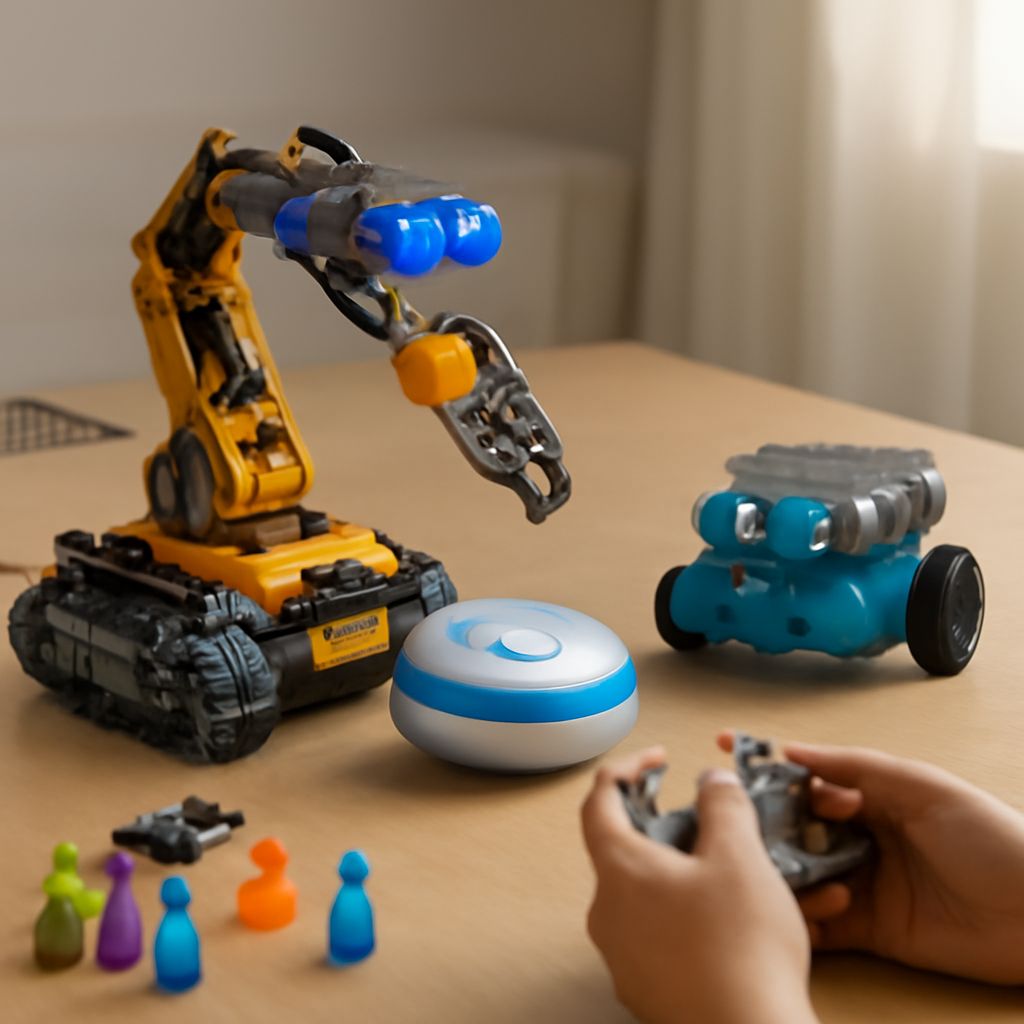
A basic diy robot arm typically consists of four to six degrees of freedom (DOF) — joints that rotate or extend to position the arm’s end effector in three-dimensional space. Each DOF is actuated by a servo motor. The base rotates the entire arm around a vertical axis. The shoulder and elbow joints provide reach and height. The wrist joints control orientation and grip angle. A final gripper or tool mount completes the kinematic chain.
Servo selection is the most critical early decision in a diy robot arm build. Standard hobby servos (SG90 class) work well for small, lightweight arms carrying loads under 100 grams. Larger metal-gear servos (MG996R class) provide enough torque for arms reaching 400 to 600 mm. Industrial-scale builds require continuous rotation servos or stepper motors with dedicated motor drivers. Matching servo torque to joint load — accounting for the mechanical disadvantage at full extension — prevents premature servo failure.
A robot arm sleeve uses flex sensors, IMUs (inertial measurement units), or potentiometers at each joint position to capture the human operator’s arm pose in real time. These readings are mapped to equivalent servo positions on the robotic arm, enabling the operator to control the robot by moving their own arm naturally. This interface is particularly valuable for learning — new operators develop an intuitive understanding of robotic kinematics by feeling the correspondence between their own movement and the robot’s response.
Advanced robot arm sleeve designs use EMG (electromyography) sensors that detect muscle activation signals rather than joint angles. This enables control of the robotic arm through intended movement rather than actual movement — a breakthrough with enormous implications for prosthetics and assistive technology. DIY EMG-based control is challenging but achievable with current accessible hardware from manufacturers like Thalmic Labs and Advancer Technologies.
Learning how to make a robot arm move smoothly requires implementing interpolation in the control software. Directly commanding servos to jump from one position to another produces jerky, unreliable motion. Smooth motion requires interpolating intermediate waypoints at a controlled velocity, easing into acceleration at the start and easing out at the end. This motion profiling is standard in industrial robotics and straightforward to implement in Arduino or Python.
Those asking how to build a robot arm for more demanding applications — pick-and-place operations, light assembly, or educational demonstrations — need to add encoder feedback to at least the major joints. Encoders report actual position rather than commanded position, enabling the controller to detect and correct for slippage, backlash, and load-induced errors. A closed-loop PID controller using encoder feedback can achieve sub-millimeter repeatability even with low-cost components.
A diy robot vacuum project teaches a complementary skill set: autonomous navigation rather than teleoperation. The basic platform consists of two driven wheels (differential drive), a caster for balance, a microcontroller, distance sensors (ultrasonic or infrared), and a cleaning mechanism (brush, fan, or both). The core algorithm alternates between forward movement and turning behavior triggered by obstacle detection.
More sophisticated diy robot vacuum builds add simultaneous localization and mapping (SLAM) — the ability to build a map of the environment while navigating it. SLAM enables systematic coverage patterns (boustrophedon or grid traversal) rather than random bouncing, significantly improving cleaning efficiency. LiDAR sensors have dropped dramatically in price, making SLAM accessible to hobbyist builders with moderate budgets.
Whether you start with a diy robot arm or a diy robot vacuum, the learning curve is genuinely steep and genuinely rewarding. Each debugging session develops diagnostic skills, each successful calibration builds confidence, and each completed project reveals the next frontier of what is possible.