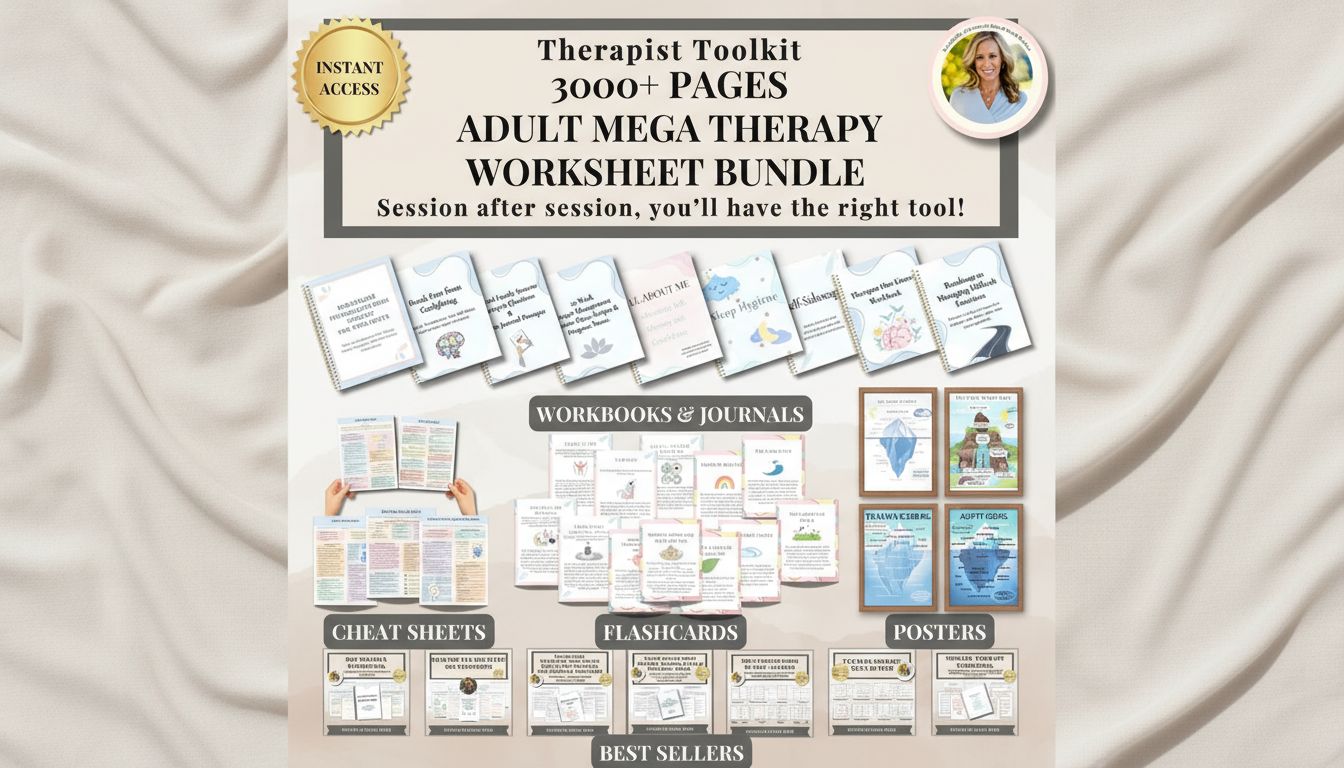
Mental health worksheets are structured written tools that help people explore thoughts, emotions, and behaviors in a guided, organized way. Psychology worksheets cover everything from cognitive restructuring exercises to emotion tracking logs, giving both clients and therapists a tangible record of therapeutic work. AI worksheets are a newer category — digital tools generated or personalized by AI to match a user’s specific presenting concerns. Mental health group worksheets adapt standard exercises for use in group therapy settings where shared reflection builds community and accountability. Printable mental health worksheets remain popular for use in low-tech settings, including schools, community clinics, and private practice offices without digital infrastructure.
This article covers the main types of worksheets, how they are used, and what the addition of AI brings to the format.
Types of Mental Health Worksheets and How to Use Them
Mental health worksheets fall into several broad categories based on their therapeutic purpose. Cognitive behavioral therapy (CBT) worksheets help clients identify automatic negative thoughts, challenge distortions, and build more balanced thinking patterns. Dialectical behavior therapy (DBT) worksheets focus on emotion regulation, distress tolerance, and interpersonal effectiveness. Both types of psychology worksheets are backed by decades of research and are widely used in clinical practice.
Emotion journals, safety plans, and values clarification exercises are other common formats. A safety plan worksheet, for example, walks a client through their warning signs, coping strategies, and emergency contacts in a structured format that can be referenced during a crisis. This kind of mental health worksheet is practical, portable, and potentially life-saving.
Mental health group worksheets require slight adaptation from individual versions. Group formats include space for shared reflection — questions about what group members noticed in themselves or in each other, for instance. The social dimension of group work changes the dynamic, and psychology worksheets designed for groups account for that. They tend to be more open-ended than individual exercises to allow for diverse responses.
Printable Mental Health Worksheets in Low-Tech Settings
Printable mental health worksheets remain the backbone of many community mental health programs. Not all clients have reliable internet access or comfort with digital tools. A paper worksheet given at the end of a session gives the client something concrete to take home. Many therapists report that clients who complete between-session worksheets show faster progress than those who do not.
The quality of printable mental health worksheets varies widely. High-quality psychology worksheets are grounded in evidence-based models and use clear, plain language appropriate to the target population. Worksheets designed for children look very different from those designed for adults; those for people with low literacy need simplified language and more visual cues.
Therapists building their own printable mental health worksheets should consider: the therapeutic goal, the client’s literacy level, the session context, and whether the worksheet will be completed in session or at home. Mental health worksheets completed in session with therapist support tend to produce more accurate responses and generate better discussion.
AI Worksheets: Personalization at Scale
AI worksheets represent a new development in the field. Rather than using a fixed template, AI-generated worksheets adapt questions based on the user’s input, creating a more personalized reflection experience. A user entering that they feel anxious about an upcoming job interview, for example, might receive a set of mental health worksheets specifically focused on cognitive distortions about performance and rejection.
The clinical utility of AI worksheets is still being studied. Early evidence suggests that personalized prompting increases completion rates and engagement compared to generic worksheets. Psychology worksheets that feel relevant — rather than formulaic — are more likely to be used consistently. AI worksheets that adapt in real time approach the personalization of a human therapist’s worksheet selection, at much lower cost and greater accessibility.
Concerns exist around data privacy and clinical oversight. AI worksheets should not replace professional care for complex presentations. They work best as a supplement to human-delivered therapy — extending the therapeutic work between sessions and making mental health group worksheets more manageable to customize at scale.
Key takeaways
Mental health worksheets are evidence-based tools that extend therapeutic work beyond the session. Psychology worksheets exist for nearly every clinical population and presenting concern. AI worksheets add personalization that improves engagement, while printable mental health worksheets remain essential in settings where digital access is limited. Mental health group worksheets adapt the same principles for shared reflection and community support.