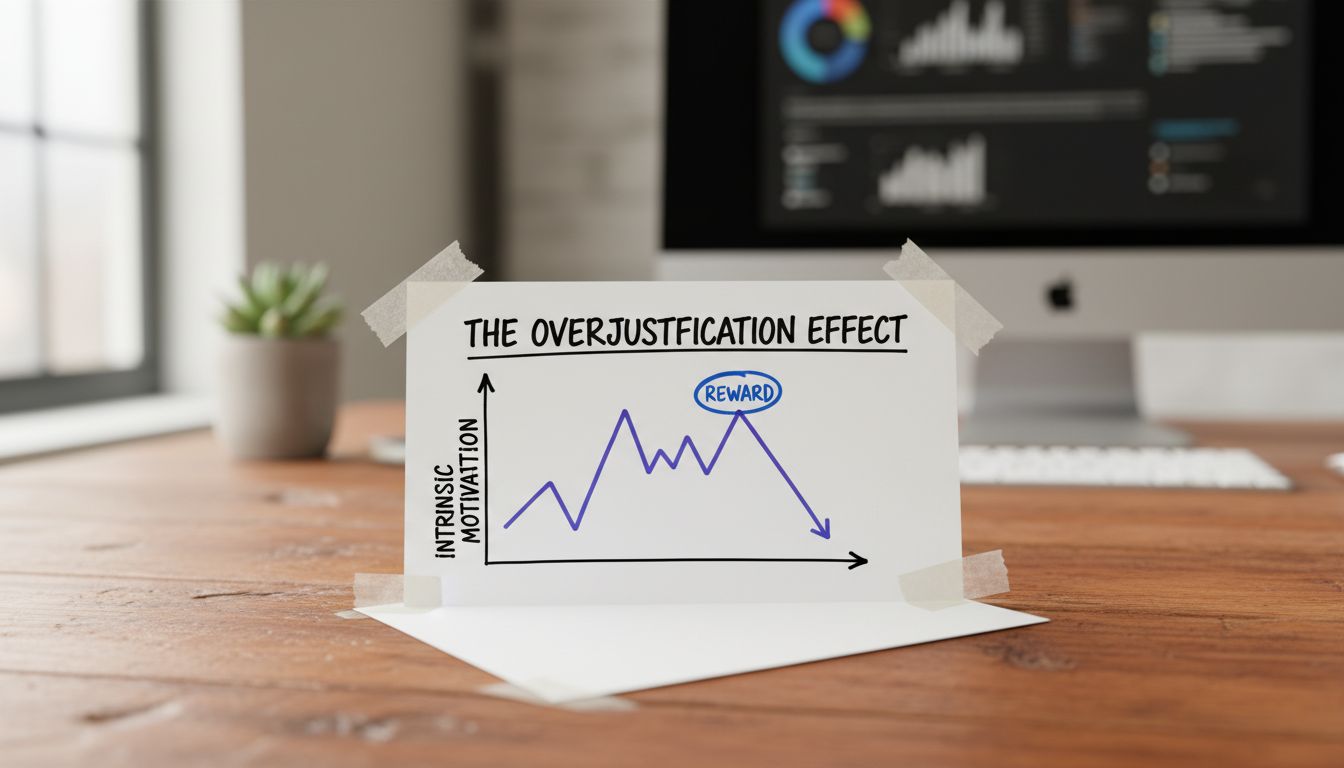
The overjustification effect psychology concept explains why external rewards can undermine intrinsic motivation. When you add a reward to an activity someone already enjoys, they may start attributing their participation to the reward rather than genuine interest. Understanding this is valuable for parents, educators, and anyone designing incentive systems. It also shows up on the ap psychology unit 1 test.
Perceptual set ap psychology covers how expectations and context shape what we perceive. The ap psychology sensation and perception test material includes this concept alongside signal detection theory, absolute thresholds, and sensory adaptation. And the overjustification effect ap psychology framing specifically addresses how this concept appears in standardized test questions and how to apply it correctly.
Overjustification Effect: Core Concept
Why External Rewards Backfire
The overjustification effect psychology phenomenon was demonstrated in a classic study by Lepper, Greene, and Nisbett (1973). Children who enjoyed drawing were given expected rewards for drawing. Later, when the rewards were removed, those children drew less than children who had never been rewarded at all. The external justification (the reward) had displaced the internal one (enjoyment).
Overjustification effect psychology applies broadly. Paying children for reading, giving grades for creative work, and offering bonuses for tasks people would do voluntarily can all reduce long-term motivation if the external reward becomes the primary reason for engaging. The effect is most pronounced when the reward is expected, tangible, and contingent on performance.
Perceptual Set AP Psychology: Expectations Shape Perception
Perceptual set ap psychology describes the mental predisposition to perceive stimuli in a particular way based on expectations, prior experience, and context. Show someone a series of letters and they’ll interpret an ambiguous figure as “B.” Show them numbers first and the same figure reads as “13.” The perceptual set ap psychology mechanism operates before conscious interpretation, filtering incoming sensory data through existing schemas.
For ap psychology tests, perceptual set questions typically ask students to identify how experience, motivation, or context affects perception. A security guard monitoring a crowd for threats is more likely to perceive ambiguous behavior as threatening than a person with no such priming. This is perceptual set ap psychology at work in real-world settings.
AP Psychology Unit 1 Test: What to Expect
The ap psychology unit 1 test covers the history and scientific foundations of psychology, including the major perspectives (biological, behavioral, cognitive, sociocultural, humanistic, psychodynamic) and research methods. Multiple-choice questions test definitional knowledge and application. Free-response questions require students to apply concepts to novel scenarios.
Common ap psychology unit 1 test topics include the difference between correlation and causation, how to evaluate research methodology, key figures in psychology’s history, and the biological bases of behavior. Students who perform well on the ap psychology unit 1 test typically focus on application over memorization, practicing scenario-based questions rather than just definitions.
AP Psychology Sensation and Perception Test
The ap psychology sensation and perception test material is one of the most concept-dense sections of the course. Key terms include absolute threshold, difference threshold (just noticeable difference), Weber’s law, signal detection theory, sensory adaptation, and perceptual organization principles from Gestalt psychology.
The ap psychology sensation and perception test also covers the major senses in detail. For vision, this includes the anatomy of the eye, how rods and cones function, color vision theories (trichromatic and opponent-process), and dark adaptation. For hearing, it covers the anatomy of the ear and the place versus frequency theories of pitch perception. Successful students connect these biological mechanisms to the psychological phenomena they produce.
Overjustification Effect AP Psychology: Test Application
Overjustification effect ap psychology questions on the AP exam typically present a scenario where an external reward has been introduced, then ask what will happen when the reward is removed. The correct answer is that intrinsic motivation will decrease, and the behavior will occur less frequently than it did before the reward was introduced.
Overjustification effect ap psychology is easily confused with reinforcement concepts from operant conditioning. The difference: reinforcement increases behavior, and the overjustification effect explains why sustained reinforcement of intrinsically motivated behavior eventually decreases that behavior. The effect operates through cognitive attribution, not conditioning schedules.
Next steps: review the overjustification effect psychology research using the Lepper 1973 study as your anchor. Practice perceptual set ap psychology questions by working through scenario-based examples. For the ap psychology sensation and perception test, build a concept map connecting sensory structures to the psychological phenomena they explain. Use the overjustification effect ap psychology framework to identify application questions quickly on practice exams by looking for the pattern: intrinsic interest, external reward added, reward removed, behavior decreases.