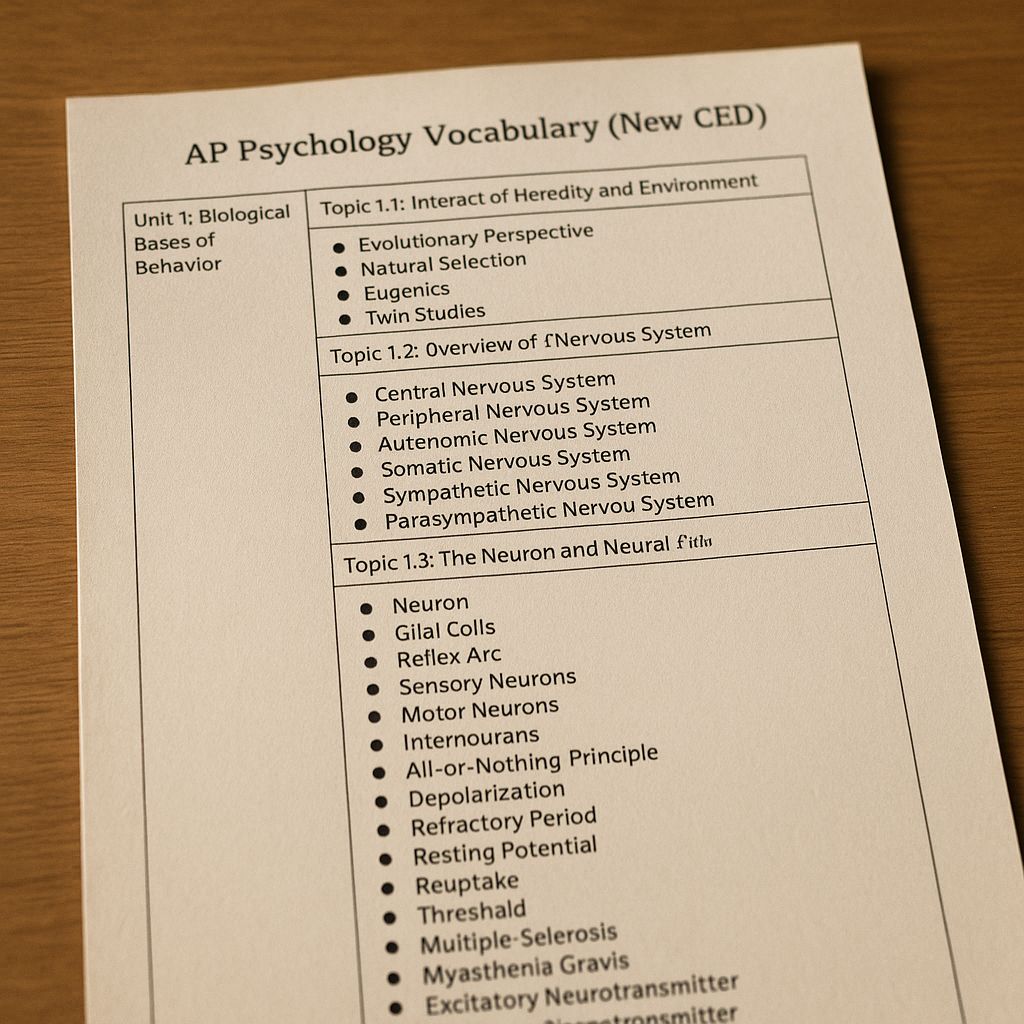
Building a strong vocabulary of psychology terms is the foundation for understanding the field. Without the right psychology words, concepts that make perfect sense in plain language become confusing when you encounter them in a textbook or exam. Students preparing for standardized tests especially need to master ap psychology vocabulary, which covers a specific and well-defined set of terms. A broad base of psychology vocabulary also serves professionals — therapists, researchers, educators, and managers all use psychological language daily. This guide covers the most important basic psychology terms and more advanced concepts across key topic areas.
Use this as a reference or a study tool — the terms are organized by theme so you can focus on one area at a time.
Core Psychology Terms From the Biological Perspective
Brain, Neurons, and Behavior
Biological psychology terms explain how the nervous system creates behavior and mental states. These are high-priority ap psychology vocabulary items that appear frequently on exams and in clinical settings.
- Neuron — the basic unit of the nervous system; cells that transmit electrical signals
- Synapse — the gap between two neurons where chemical signals (neurotransmitters) are passed
- Neurotransmitter — a chemical messenger; examples include dopamine, serotonin, and GABA
- Central nervous system (CNS) — the brain and spinal cord; processes and coordinates information
- Peripheral nervous system (PNS) — all nerves outside the CNS; includes somatic and autonomic systems
- Cerebral cortex — the outer layer of the brain involved in higher-order thinking, language, and perception
Understanding these biological psychology words helps you connect brain structure to behavior. When you read that depression involves reduced serotonin activity, you know what serotonin is and where it acts. That context makes every other concept clearer.
Learning and Conditioning: Key Psychology Vocabulary
Learning theory is one of the most tested areas in ap psychology vocabulary and a core part of basic psychological training. These terms come from behaviorism — the school of psychology focused on observable behavior and its causes.
- Classical conditioning — learning by association; a neutral stimulus comes to produce a response after being paired with a stimulus that naturally produces that response (Pavlov’s experiments)
- Operant conditioning — learning through consequences; behavior is strengthened by reinforcement or weakened by punishment (Skinner’s work)
- Positive reinforcement — adding something pleasant to increase a behavior
- Negative reinforcement — removing something unpleasant to increase a behavior (not punishment)
- Extinction — the gradual weakening of a conditioned response when reinforcement stops
- Stimulus generalization — responding to stimuli similar to the original conditioned stimulus
These basic psychology terms from learning theory apply directly to everyday situations — parenting, education, workplace behavior, and therapy all rely on these principles. Knowing them precisely prevents common confusions, especially around negative reinforcement, which is frequently misunderstood.
Cognitive and Developmental Psychology Terms
Cognitive psychology vocabulary covers mental processes: how you perceive, remember, think, and solve problems. Developmental terms describe how these processes change from infancy through old age.
- Schema — a mental framework for organizing and interpreting information
- Cognitive dissonance — discomfort from holding conflicting beliefs or behaving inconsistently with your beliefs
- Working memory — the system that holds and manipulates information in the short term
- Long-term potentiation (LTP) — strengthening of synaptic connections with repeated activation; underlies memory formation
- Accommodation — adjusting an existing schema to fit new information
- Zone of proximal development (ZPD) — Vygotsky’s term for what a learner can do with guidance but not yet independently
These are core psychology terms for anyone studying education, child development, or cognitive science. The ZPD concept alone has shaped decades of teaching practice. Cognitive dissonance appears in research on attitude change, persuasion, and moral psychology.
Social and Clinical Psychology Words
Social psychology words describe how people behave in groups and how others influence individual thought and action. Clinical terms describe mental health conditions and treatment approaches.
- Conformity — changing behavior or beliefs to match a group norm
- Obedience — following direct instructions from an authority figure
- Diffusion of responsibility — the tendency to feel less personal accountability when others are present (bystander effect)
- DSM-5 — the Diagnostic and Statistical Manual of Mental Disorders, 5th edition; the standard classification system for mental health diagnoses
- Cognitive-behavioral therapy (CBT) — a treatment approach that targets unhelpful thought patterns to change behavior and emotion
- Placebo effect — improvement in symptoms caused by the expectation of treatment rather than the treatment itself
Next steps: Go through each category and cover the definitions. Write each term in a sentence using your own words — not the textbook definition. Then review with a partner or use flashcard software to test recall. Connecting ap psychology vocabulary to real examples from your own life is the fastest way to retain these terms past exam day.