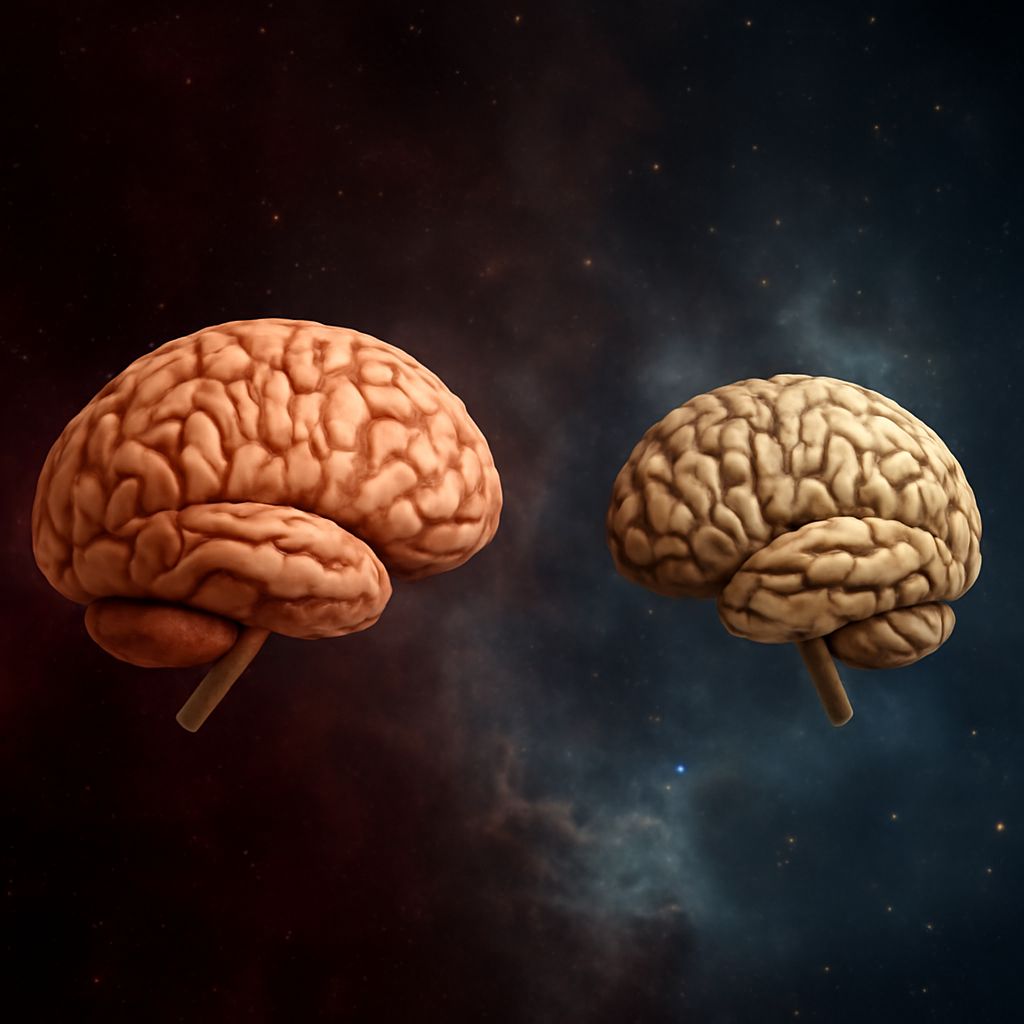
The thought experiment involving a brain named after Boltzmann is sometimes mistaken for a scientific claim that human minds appeared spontaneously out of empty space. It makes a conditional argument: if a cosmological model produces overwhelmingly more accidental observers than ordinary ones, the model may struggle to explain why observations like ours are trustworthy.
The name refers to Ludwig Boltzmann, whose work helped connect thermodynamics with probability. The hypothetical observer is a tool for testing ideas about a universe and its history, rather than an account of how people on Earth developed. Understanding the puzzle begins with the relationship between probability, entropy, and time.
Boltzman brain: what the hypothetical observer represents
A Boltzmann brain is an imagined observer that arises through an extraordinarily unlikely fluctuation, rather than through the familiar sequence of stars, planets, biological evolution, and development. It might have a fleeting experience and apparent memories, even though those memories have no corresponding personal history. The label brain is shorthand for a physical arrangement capable of observation; exactly what arrangement would support experience is itself an open question.
A boltzman brain would, in this scenario, possess apparent experiences without the ordinary history that those experiences seem to imply. Its proposed existence depends on the physical processes allowed by the model.
Suppose a box of gas is in equilibrium, spread throughout its available space. Random molecular motion makes uneven arrangements possible. A modest local concentration is far more plausible than a highly coordinated arrangement of every molecule. In a suitable model, waiting gives rare arrangements more opportunities to occur, although the details depend on the system and its physical laws.
The Boltzmann brain scenario extends this analogy to a much larger setting. If some physical process can produce observer-like fluctuations, and the relevant region lasts sufficiently long, even extremely rare events might accumulate. Whether the actual universe supplies those conditions is a separate scientific question. The argument cannot simply assume that a box of gas and the expanding universe behave in identical ways.
Why entropy enters the story
Entropy is often described as disorder, but its statistical meaning is more precise: it relates to how many microscopic arrangements are compatible with a large-scale state. A gas spread evenly through a container corresponds to vastly more microscopic arrangements than the same gas confined to one corner. That difference makes the spread-out state overwhelmingly favored under ordinary conditions.
The observable universe presents a striking historical feature. Its early state was special in a way that allowed entropy to increase over cosmic time. Gravity complicates the everyday picture: a smooth early distribution can have low gravitational entropy even when matter and radiation are hot and dense. As structure formed, stars, galaxies, and black holes became part of a long physical history in which local complexity developed alongside an overall thermodynamic tendency.
A fluctuation explanation asks whether an ordered region could instead emerge by chance from a much higher-entropy background. The difficulty is that producing an entire extended history with galaxies, fossils, laboratories, and observers appears to require a much larger departure from equilibrium than producing one observer with the apparent memories of such a history. In the relevant models, the smaller departure may therefore be far more probable.
That comparison involving Boltzmann’s hypothetical brains is the source of the puzzle, not a calculation that applies to every imaginable universe. It depends on what fluctuations are physically allowed, which configurations count as observers, and how probabilities are assigned. Those assumptions must be stated before the comparison has force.
From a rare event to a dominant observer
The argument about a brain arising in Boltzmann-style fluctuations can be expressed as a conditional sequence:
- A model contains a region that persists for an immense time and admits some process that creates accidental observers.
- It also produces ordinary observers through a low-entropy cosmic history, but their production does not keep pace with accidental observations in the chosen comparison.
- Under a specified counting rule, most observers with experiences sufficiently like ours are then accidental.
- If an observer should regard their experience as typical of that reference class, the model seems to predict that the observer is accidental too.
Every step matters. A tiny production rate alone does not establish dominance; the number of ordinary observers, the duration and extent of the relevant region, and the comparison rule all matter. If both populations are infinite, dividing one total by another is not straightforward. A measure, or prescription for assigning relative probabilities, can affect the result.
The reference class for Boltzmann’s imagined brain matters as well. Counting every conceivable observer differs from comparing observers with the same current evidence. The latter comparison makes the problem more pointed: an accidental observer could, in the thought experiment, momentarily possess the same apparent records and experiences as an ordinary one. The question is whether the theory makes such misleading appearances typical among observers who have that evidence.
In a model that permits boltzman brains, their relative abundance depends on the duration and dynamics of the regions in which they might arise. In the scientific literature, Boltzmann brains are discussed as a problem for particular models, not as a detected population. A rare possibility becomes a challenge only when the model and its probability prescription make it dominant in the relevant comparison.
Why the prediction can undermine the model
An accidental observer with an apparent lifetime of memories would mostly be mistaken about the past those memories seem to record. The same concern extends to apparent observations of stars, laboratory instruments, and published research. If a theory tells an observer that such evidence is probably a product of a brief fluctuation, it also calls into question the evidential history used to arrive at the theory.
This is why physicist Sean Carroll argues that models dominated by accidental observers face a serious problem: they threaten the reliability of the reasoning used to assess them. His discussion of why such observers are problematic focuses on observers locally indistinguishable from ordinary ones. Other researchers debate the philosophical force of this objection, including which assumptions about typicality are justified.
The issue is not resolved by declaring that a momentary observer would notice a strange environment. The sharpest version compares an observer with the same present evidence as ours. The difference concerns the history and wider physical situation behind that evidence. A model that makes ordinary histories typical has a clearer route to treating the accumulated agreement among observations as evidence about a real, persistent world.
Which cosmic assumptions could change the conclusion?
One discussion concerns a universe approaching a long-lived de Sitter-like state, associated with accelerated expansion and a horizon temperature. Some treatments suggest such a state could support extremely rare observer-producing fluctuations. Whether that description follows from a particular account of quantum physics is disputed; it should not be presented as an established observation.
For example, Boddy, Carroll, and Pollack argue that a stationary de Sitter vacuum need not produce the relevant fluctuations. Other analyses investigate whether a vacuum’s finite lifetime could prevent the accidental population from overwhelming ordinary observers. A sufficiently rapid change or decay might limit the opportunities available, though the conclusion depends on the model and measure. Neither proposal settles every formulation of the problem.
A different response examines the counting procedure itself. In a very large or eternal cosmology, researchers must specify what is being counted, where, and under what cutoff or probability measure. A comparison that changes with those choices signals that the measure needs independent justification; simply picking one that gives a preferred answer would not explain why it is appropriate.
Researchers can also question whether the proposed physical configurations actually support experience. That question touches the unresolved relationship between physical processes and consciousness. Treating every brief brain-like arrangement as an observer is an assumption to examine, not a discovery about minds.
What does the paradox mean for cosmology?
The value of the Boltzmann-style brain thought experiment is methodological. It asks whether a model that describes cosmic history also makes the evidence used to evaluate that history reasonably credible. If accidental observers dominate under a model’s own assumptions and comparison rule, cosmologists have a reason to inspect its physical dynamics, measure, and assumptions about observers.
Does the paradox show that humans are accidental fluctuations? No. It identifies a possible failure in certain interpretations of certain cosmological models. Its continuing importance is that an account of the universe must explain not only what it can contain, but how its predictions connect to the evidence available to observers within it.