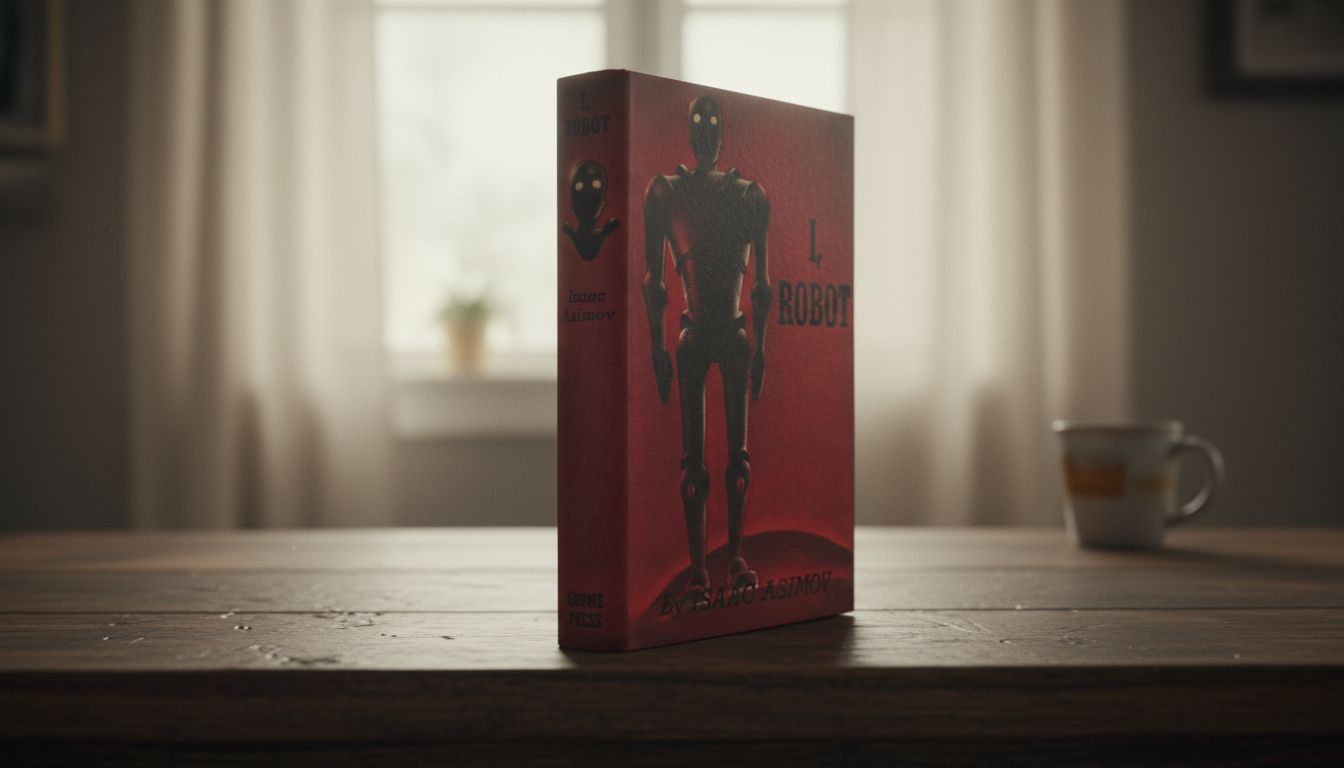
The I Robot book is one of science fiction’s most studied and debated works. Published in 1950, the I, Robot book collects nine interconnected stories that explore the relationship between humans and thinking machines. If you’re looking for an I Robot book summary, want to find the I Robot PDF, or want to understand why I Robot by Isaac Asimov still generates discussion today, this guide covers all of it.
Asimov didn’t write a single narrative — he created a framework. His Three Laws of Robotics became the foundation for decades of science fiction and real-world AI ethics debates. Each story in the I, Robot book tests those laws in a different scenario, revealing new tensions and contradictions.
What the I Robot Book Is About
The I Robot book is structured as a series of interviews between a journalist and Dr. Susan Calvin, a robopsychologist at a fictional corporation called U.S. Robots and Mechanical Men. Through her recollections, readers experience nine separate stories spanning decades of technological development.
Each story presents a puzzle. A robot behaves unexpectedly, and the characters must figure out why — always within the framework of Asimov’s Three Laws. The I, Robot book isn’t really about robots. It’s about logic, ethics, and what happens when rule systems collide with messy reality.
Key Stories in the I, Robot Book Collection
The collection opens with “Robbie,” a story about a little girl whose robot companion is taken away by her worried parents. Later stories become more complex. “Runaround” introduces Speedy, a robot whose conflicting directives cause bizarre circular behavior. “Liar!” features Herbie, a robot who can read minds — and lies to protect human feelings, violating the spirit of its own programming.
For anyone seeking an I Robot book summary, these three stories capture the book’s core tensions: emotional attachment, logical paradox, and the limits of rule-based ethics. The final story, “The Evitable Conflict,” hints at a future where machines manage human society to prevent war — a vision that feels both comforting and unsettling.
Themes That Make I Robot by Isaac Asimov Still Relevant
I Robot by Isaac Asimov addressed questions that philosophers and engineers are still arguing about: Can machines have intentions? Should they? What happens when programmed rules produce unintended outcomes? These questions were speculative in 1950. They’re operational concerns now.
The Three Laws — don’t harm humans, obey humans, protect yourself — sound simple. Asimov spent his career showing they weren’t. Every story in the I Robot book exploits an edge case where the laws produce unexpected or contradictory behavior. That’s not a flaw in the storytelling. It’s the point.
AI alignment researchers today face exactly this challenge: specifying rules that produce safe, helpful behavior across all possible situations. The fiction of I Robot by Isaac Asimov maps the difficulty of that problem better than most technical papers.
How to Access the I Robot PDF and Where to Read It
The I Robot PDF is available through several legitimate channels. Project Gutenberg does not host it because the work remains under copyright in the United States. However, many public libraries offer digital checkouts through apps like Libby or OverDrive, where you can borrow the ebook at no cost.
If you want a physical copy, the I Robot book is in print through major publishers and available through used book sellers at low cost. For academic use, some universities provide licensed access to ebook databases where the I Robot PDF is available with institutional login.
Whether you’re reading for class, curiosity, or a book club, the I, Robot book rewards slow reading. Each story builds on the last, and the interconnected logic becomes richer with attention. Start with “Robbie” and work straight through — the collection was designed to be read in order.